
“The engineering value of this achievement is highly significant. We welcome you to join our R&D team after graduation!”
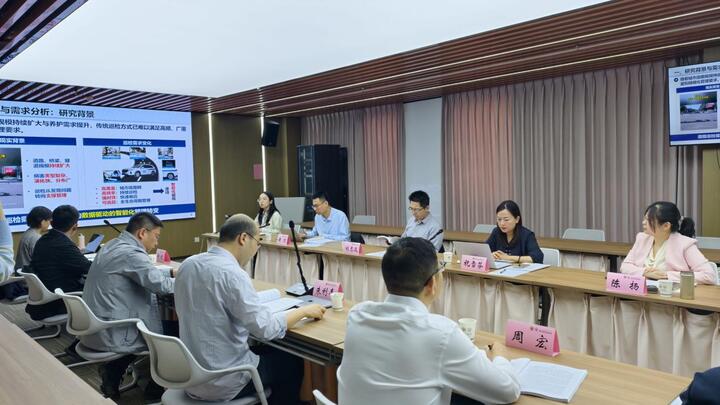
On the morning of May 8, a master’s degree defense based on practical achievements, rather than a traditional academic thesis, had just concluded at the National Institute of Excellent Engineers of Southeast University. Before master’s student Yang Shiqi could even step down from the defense stage, two technical executives from leading industry enterprises, seated on the review panel, both extended job invitations to her.
What impressed the two “examiners” and prompted them to compete for her on the spot was not a highly cited academic paper, but a “LiDAR-Vision Integrated Intelligent Road Inspection System” that had already traveled more than 7,800 kilometers on the streets of Nanjing. Yang Shiqi, the student leader of the project, is also the first fresh graduate at Southeast University to apply for a master’s degree through a practical achievement report. This reform path marks the in-depth advancement of engineering master’s and doctoral training reform in Jiangsu.
“Borrowing a Vessel to Go to Sea”: Giving Buses “Eyes”
“What our system aims to solve is an engineering pain point: problems can be seen, but their exact locations cannot be found,” Yang Shiqi explained.
Traditional road inspection mainly falls into two categories. Manual inspection depends heavily on experience and is inefficient. Visual detection can identify road defects, but its positioning capability is weak. In other words, it can detect that a crack exists, but it cannot clearly determine which lane the crack is in or how far it is from the curb, making it difficult for maintenance workers to repair it directly.
“Relying on the Excellent Engineer project led by Professor Liu Zhiyuan’s team at Southeast University, we developed a LiDAR-vision fusion solution and installed the inspection system on the roofs of buses. LiDAR is responsible for spatial positioning, while cameras are responsible for image recognition. After fusion, the system can locate road cracks within 0.5 meters. Simply put, it gives buses ‘eyes’ and can even tell you whether the crack was seen by the ‘left eye’ or measured by the ‘right eye’,” Yang said.

However, technology alone is not enough. The next question is how to deploy the technology on a large scale at low cost.
“We chose a strategy of ‘borrowing a vessel to go to sea’,” Yang said. A traditional professional inspection vehicle often costs more than one million yuan and requires dedicated procurement, maintenance, and drivers. By contrast, the system she led in developing costs only 20,000 to 30,000 yuan.
“City buses already run fixed routes every day. We simply let them take a look at the road surface along the way. No extra fuel is consumed, no additional labor is needed, and the inspection task is completed automatically,” she added.
In addition, to address the data redundancy caused by buses repeatedly running along the same routes at high frequency, the team designed an intelligent deduplication mechanism.
“The same crack may be photographed dozens of times a day. The system can automatically judge, like an experienced road maintenance worker, whether it is a newly discovered crack or the same old spot captured again,” Yang explained. This mechanism has reduced duplicate records by more than 90%.
At present, the system has been deployed on three bus routes and one professional inspection vehicle in Nanjing. It has also been successfully applied to road support tasks for major events such as the Nanjing Marathon. Its application model of “zero additional transport capacity, high-frequency coverage, and low-cost operation and maintenance” has been included in theNanjing Action Plan for Further Promoting the Development of “AI + Transportation” Application Scenarios. The related project achievement won the First Prize of the 2025 Science and Technology Progress Award of the China Communications and Transportation Association.
Going to the Front Line to Solve Real Problems
“This system works well in Nanjing, but can it adapt to road conditions in Zhejiang? There are many tunnels there, and mountain roads are complex,” asked Wu Cairui, Director of the Transportation Planning Institute of Jiangsu Provincial Planning and Design Group Co., Ltd. and a senior engineer, during the defense.
Yang Shiqi did not avoid the question. She frankly acknowledged that positioning inside tunnels is indeed a current technical difficulty. If the system is to be promoted in areas such as Zhejiang, where there are many tunnels, further optimization of inertial navigation accuracy and algorithms will be needed.
“But this is precisely the real state of engineering implementation. There is no perfect solution, only a path of continuous iteration,” she said.
Her candid answer drew repeated nods from the experts present.
The greatest difference between a practical achievement defense and a traditional academic thesis defense lies precisely in these “real problems.”
“In a traditional thesis defense, experts are more concerned with what scientific problem you have solved. In a practical achievement defense, the focus is on engineering problems: Can users actually use it? Is the cost controllable? Is it replicable? These are exactly the key indicators that test whether the achievement itself is truly substantial,” said Huang Kai, Yang Shiqi’s advisor and an associate professor at the School of Instrument Science and Engineering of Southeast University.
Yang Shiqi herself shifted from a traditional thesis route to a practical achievement defense. She had originally completed a large amount of preliminary work following the academic thesis approach. However, after learning that the university was promoting the policy of graduation based on practical achievements, she resolutely decided to switch tracks.
“My achievement is most intuitively presented through a practical report, so I wanted to take on this challenge,” she said.
Yang recalled that the first version of her practical report was returned by her advisor because it still looked too much like a thesis and lacked sufficient engineering details.
“A traditional thesis values depth. You need to dig deeply into one specific point. But practical achievements value breadth. You need to run through the entire chain, including detection, positioning, deduplication, hardware integration, and engineering implementation,” she said.
For this reason, she reorganized the content and added many details about installation, debugging, and field testing. She even included the problems encountered when installing equipment on bus roofs, such as skylights, roof curvature, and height-limit barriers.

“Switching to a practical achievement defense does not mean the threshold is lowered. On the contrary, it is a different, more difficult, and more comprehensive form of assessment. But it also gives me a better stage to present my research achievements,” Yang said. “It forces you to truly go deep into the front line and face real problems.”
From Doctoral Students to Master’s Students: A Two-Way Transformation
In 2026, Southeast University successively saw Jiangsu’s first engineering doctoral student applying for a degree through practical achievements and the university’s first “practical master’s” graduate. The systematic implementation of this pathway, from doctoral to master’s education, is not accidental. It marks the transition of a training philosophy from individual pilot cases to systematic advancement.
“In recent years, we have explored a full-process reform path, including project-based enrollment, university-enterprise joint training, student practice in enterprises, and degree application based on practical achievements,” said Chen Yang, Deputy Party Secretary and Vice Dean of the National Institute of Excellent Engineers of Southeast University.
Chen observed that the mindsets of university advisors, enterprise advisors, and even enterprise human resources departments are gradually changing, as the reform moves from pilot exploration toward broader promotion.
Zhu Xuefen, Director of the Degree Office of the Graduate School of Southeast University, said that allowing students to apply for master’s and doctoral degrees based on practical achievements is an important reform measure by the university to implement the national Excellent Engineer Education and Training Program and deepen industry-education integration.
The core of the reform, she noted, is to highlight engineering practice, emphasize problem solving, focus on achievement application, and comprehensively evaluate the overall engineering capabilities of professional degree graduate students.
In Chen Yang’s view, this pathway has brought about a “two-way transformation” for both students and teachers. For students, more and more engineering master’s and doctoral students are working in real enterprise scenarios, tackling real projects, and producing real outcomes. For teachers, the joint training process between university and enterprise advisors also promotes mutual learning. Enterprise advisors gain a better understanding of frontier academic research, while university advisors better understand the real needs of enterprises and how technologies can be implemented.
“We especially encourage students who are more inclined toward industry rather than purely academic research to directly transform their training process into the starting point of their careers and bravely challenge themselves by applying for a degree through practical achievements,” said Professor Liu Zhiyuan, Secretary of the Party Branch directly under the School of Statistics and Data Science of Southeast University.
Liu noted that practical achievement-based training is also a self-renewal of teaching philosophy for faculty members.
“Teachers need to take the initiative to step out of their academic comfort zones, visit enterprises, observe real conditions, and understand actual engineering constraints. If students are like on-site project managers, then teachers need to guide them hands-on in front-line communication. These abilities cannot be taught by simply sitting in a laboratory,” he said.
“We hope that graduation based on practical achievements will no longer be a ‘brave person’s game’ chosen by only a small number of students, but will become one of the mainstream choices for engineering master’s and doctoral students in the future,” Chen Yang revealed.
At present, Southeast University is promoting the opening of more real projects by partner enterprises, enabling more students to deeply participate in solving front-line industrial problems during their graduate studies.
Reposted from the WeChat official account ofJunction News.
