

On October 25, the Southeast University-CETC University-Enterprise Mentor Exchange Meeting, co-hosted by Southeast University and China Electronics Technology Group Corporation (CETC), was held in Nanjing. Jin Shi, Vice President of Southeast University and Dean ofthe National Graduate College for Elite Engineers, Yang Jiamu, Executive Vice President, Xu Haiping, Vice President of CETC Graduate School (Party School), and Zhang Xin, Deputy Director of CETC 28th Research Institute, attended the event.
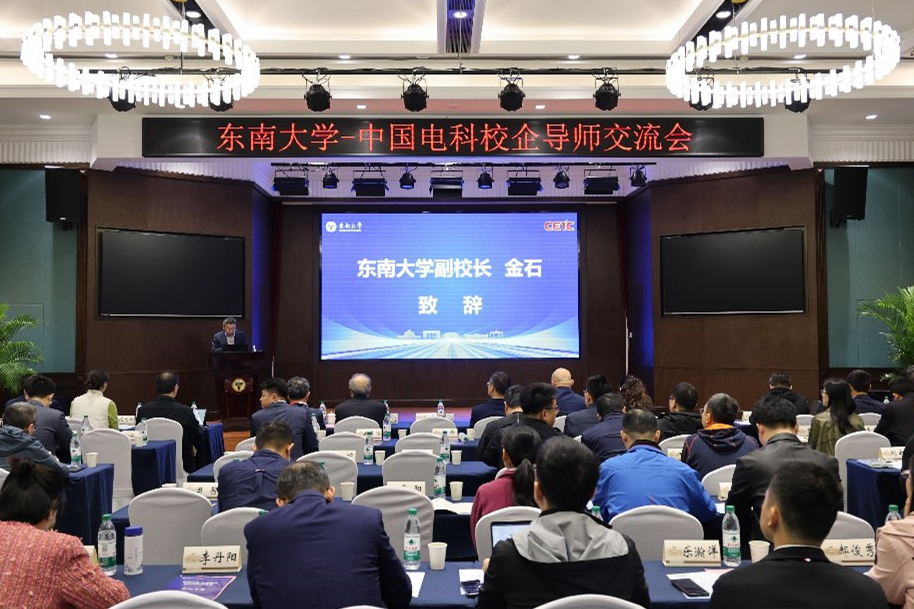
In his address, Jin Shi noted that as a backbone of China's defense electronics industry, CETC boasts core businesses that align closely with Southeast University's strengths in engineering. The two sides enjoy a solid foundation and promising prospects for cooperation. He mentioned that in recent years, the university has advanced a project-based training model for elite engineers. Focused on solving real-world engineering problems, it has established interdisciplinary university-enterprise mentor teams, setting a fine example for collaborative innovation among industry, academia and research. He also presented the university's achievements in multi-party cooperation between government, enterprises, universities and local institutions. He highlighted diversified efforts to improve the overall quality of engineering education through specialized technology centers for elite engineers, high-quality curriculum systems and postgraduate assessment reforms. He expressed the hope that both sides will take this exchange as an opportunity to expand cooperation in scope and depth, and make greater contributions to national scientific and technological innovation and industrial development.
In his speech, Yang Jiamu stated that CETC has thoroughly implemented national requirements and attaches great importance to the training of elite engineers. He pointed out that projects serve as a vital platform, mentors play a key role, and high-caliber students form the foundation for talent cultivation. It is essential to deepen university-enterprise collaboration and integration of industry and education, and boost talent development and research output through cross-departmental cooperation. He also stressed extending talent training to earlier stages of education. Yang added that CETC will draw on expertise from diverse fields, give full play to the role of dual university-enterprise mentors and strengthen mentor training, so as to nurture talents through distinguished mentors and high-quality research projects. The group will further strengthen cooperation with Southeast University and advance all-round collaboration with talent training as the core link.
During the keynote session, five experts delivered presentations on academic training, engineering practice and industrial trends for elite engineers — topics of mutual concern to both parties. The speakers included Hong Wei, Distinguished Professor of Southeast University; Yu Zongguang, Chief Scientist of CETC; Shi Longxing, Distinguished Professor of Southeast University; Xia Linghao, Executive Deputy Director of the Radar Detection and Perception Laboratory at CETC 14th Research Institute; and Huang Guangbin, Distinguished Professor of Southeast University. Their sharing offered new insights for interdisciplinary research and comprehensive cooperation across various fields.
In the afternoon, four parallel sub-forums were held simultaneously, covering training of elite engineers in next-generation information and communication technologies, integrated circuits and semiconductors, artificial intelligence and unmanned systems, as well as process management and competency standards for engineer training. Centering on innovative models and collaborative mechanisms, participating experts held in-depth discussions on building future-oriented training systems for engineers across different disciplines.
The holding of the Southeast University-CETC University-Enterprise Mentor Exchange Meeting marks a new milestone in the joint training of elite engineers. Going forward, the two sides will continue to work together to advance integration of industry, academia and research as well as technological innovation, injecting new momentum into China's engineering education and industrial development.
