
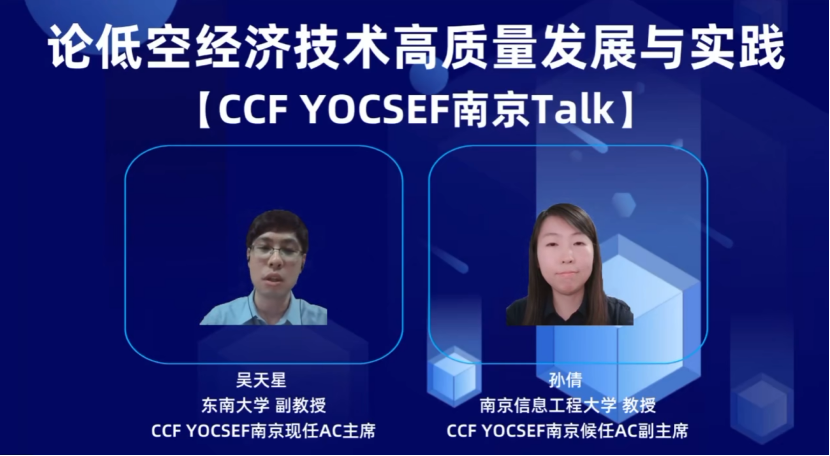
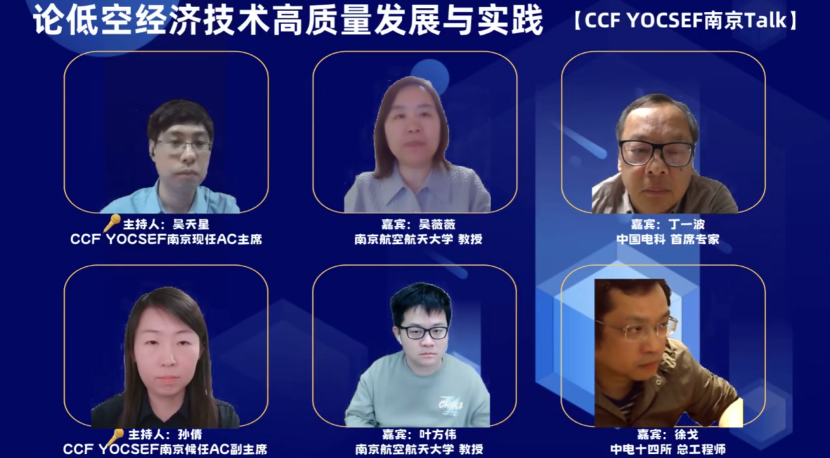
On March 23, 2025, with the support of the DataFun community and the Jiangsu Aviation Industry Association, CCF YOCSEF Nanjing organized an online CCF YOCSEF Nanjing Talk titled “On the High-Quality Development and Practice of Low-Altitude Economy Technology.” The event invited Professor Wu Weiwei from Nanjing University of Aeronautics and Astronautics, Professor Ye Fangwei from Nanjing University of Aeronautics and Astronautics, Chief Expert Ding Yibo from China Electronics Technology Group Corporation, and Senior Engineer Xu Ge from the 14th Research Institute of CETC to jointly explore hot topics in low-altitude economy technology breakthroughs, integrated innovation, and practical applications. A panel discussion was held under the theme “In the race to build a ‘sky city,’ how can theory, technology, and practical applications be mutually integrated and reinforced?” The discussion covered multiple dimensions, including technology, scenarios, institutions, and ecosystem development. The session was co-moderated by Professor Sun Qian, incoming Vice Chair of CCF YOCSEF Nanjing (Nanjing University of Information Science and Technology), and Associate Professor Wu Tianxing, current Chair of CCF YOCSEF Nanjing (Southeast University).
At the beginning of the event, Wu Tianxing introduced the background and preparation of the talk, noting that the low-altitude economy has heated up rapidly in recent years and has become a strategically emerging industry that the country is prioritizing. It urgently requires collaborative exploration across disciplines and fields. Sun Qian then introduced the distinguished guests and assisted in guiding the discussion and exchange on each topic.
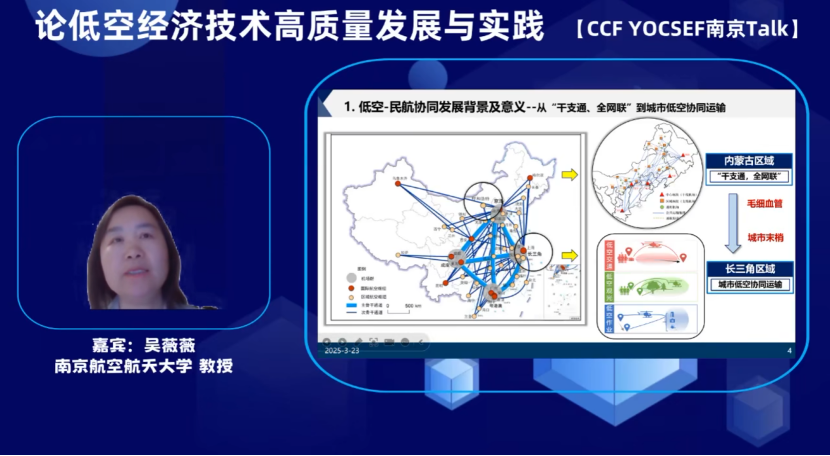
In the opening remarks session, Wu Weiwei first gave an in-depth presentation on “A New Paradigm of Urban Low-Altitude Collaborative Transportation for Future Mobility.” She pointed out that the low-altitude economy has become an important direction for coordinated civil aviation development. Under the guidance of the “trunk-feeder-through, fully networked” strategy, low-altitude transportation is helping China’s transport services shift from broad coverage to more refined and three-dimensional development. New aircraft represented by drones and eVTOLs have shown great application potential in short-distance urban mobility, logistics delivery, medical rescue, and other areas. Internationally, countries such as the United States, the United Kingdom, and the United Arab Emirates have successively established urban air traffic management systems to promote scenario-based applications; domestically, cities such as Suzhou, Shenzhen, and Chongqing have also made positive progress in low-altitude economy infrastructure construction and scenario innovation. Wu noted that low-altitude transportation still faces practical challenges such as limited airspace resources, an underdeveloped safety supervision system, weak infrastructure, and insufficient public acceptance. Looking ahead, Jiangsu Province will take technological breakthroughs as the driver, coordinate innovation-driven development, scenario introduction, and cross-regional cooperation, and strive to build a full-chain ecosystem spanning design, manufacturing, operation, and services, as well as a smart low-altitude logistics network covering urban and rural areas and radiating across China and the world, thereby supporting the construction of a world-class Yangtze River Delta city cluster.
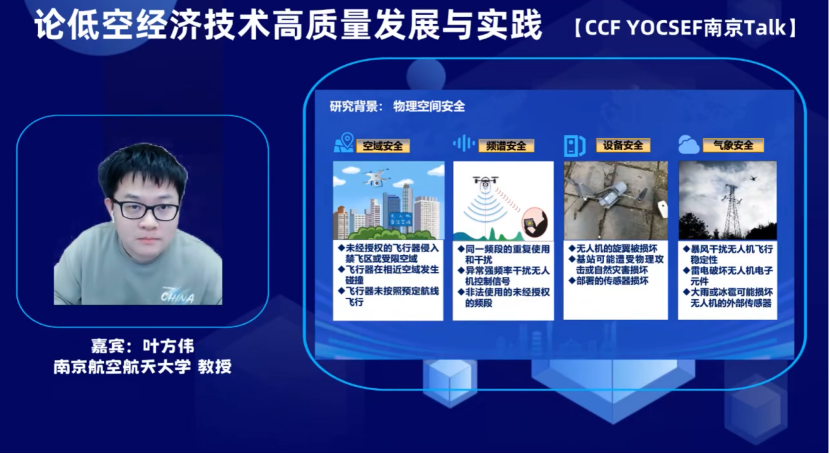
Next, Ye Fangwei shared insights on “Research on Security Governance Mechanisms for the Low-Altitude Internet of Things.” He pointed out that the low-altitude Internet of Things, as a core infrastructure for the development of the low-altitude economy, is gradually becoming an important pillar supporting the deep integration of the low-altitude economy and smart transportation. However, the development of the low-altitude economy also faces numerous security challenges, especially in areas such as unauthorized drone flights, signal interference, cross-domain identity authentication, and distributed monitoring. Regarding the construction of a security system for the low-altitude Internet of Things, Ye systematically analyzed multi-dimensional security risks involving physical space, cyberspace, and data space, and proposed a low-altitude security supervision framework centered on “integrated communication, sensing, guidance, and control,” with a focus on building a low-altitude intelligent network system that is usable, manageable, and controllable. He also shared demonstration applications from the team in areas such as Nanjing Jiangxinzhou Drone Technology Island. Ye emphasized that the development of security capabilities is not only the technical foundation for ensuring the high-quality development of the low-altitude economy, but also the key to enhancing public trust and government governance capacity. In the future, the team will continue to focus on core technological breakthroughs and practical validation in low-altitude security supervision, helping China’s low-altitude economy and smart transportation system advance steadily.
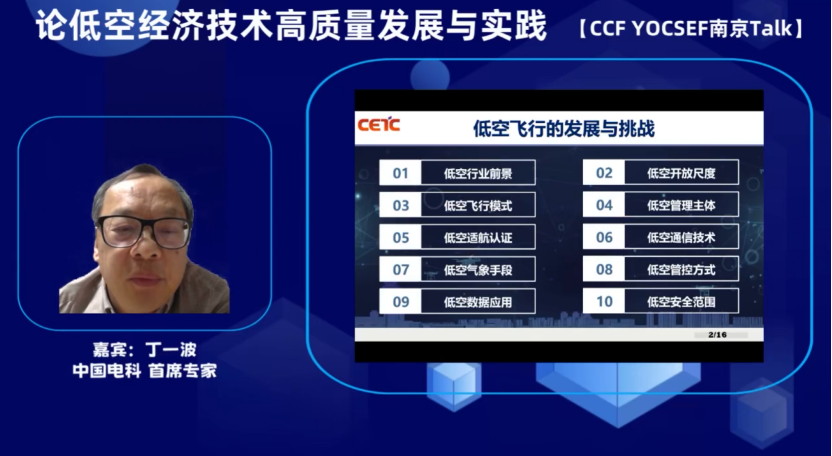
Ding Yibo then delivered a presentation titled “Development Trends and Technical Challenges in Low-Altitude Flight Management.” He analyzed the current development status and core issues of the low-altitude economy. He pointed out that although the low-altitude economy is regarded as a future trillion-yuan industry, it is still in the early stages of exploration and accumulation. It is necessary to remain rational and patient in vision planning, technological breakthroughs, and governance system construction, and avoid rushing for quick success. On industry development, he systematically outlined ten key issues facing low-altitude flight management, covering industrial prospects, airspace opening scale, flight rule systems, evolution of management mechanisms, airworthiness certification systems, communication support capabilities, micro-weather support, detection and countermeasure technologies, data governance capabilities, and full-chain safety system construction. Technically, he focused on challenges such as low-altitude communication continuity, micro-scale weather support, target detection and counter-interference, and full-process safety governance, noting that obvious bottlenecks remain in many core capabilities. Finally, Ding introduced China Electronics Technology Group’s research layout in low-altitude airspace management, flight services, communication-navigation-monitoring, and target protection, and shared the development progress of products such as “Tianxing,” “Tianwei,” and “Tiangong,” offering new framework ideas for improving low-altitude flight management systems and promoting the high-quality development of the low-altitude economy.
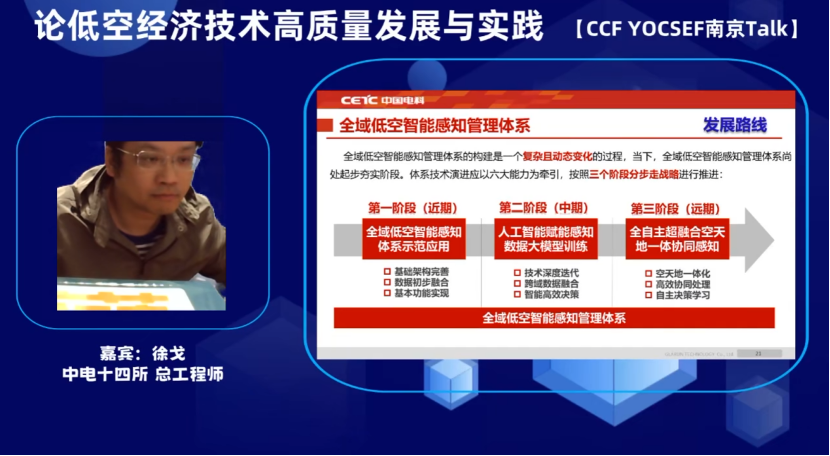
Xu Ge then presented an in-depth sharing on “A Full-Domain Low-Altitude Intelligent Sensing and Management System Solution.” He noted that the low-altitude sensing system is a core capability for ensuring flight safety and supporting the high-quality development of the low-altitude economy, but it still faces multiple challenges such as insufficient sensing capability, immature integration technologies, and weak management decision-making systems. He introduced the basic connotation, core requirements, and key challenges of the low-altitude sensing system, and elaborated on a construction approach based on six capability frameworks: ubiquitous sensing, full-domain coverage, multi-source fusion, intelligent management and control, reliable operation, and cross-domain interconnection. He proposed building an integrated platform for real-time situational awareness, intelligent analysis, and collaborative decision-making based on a cloud-edge-device cooperative architecture, in order to improve the safety, stability, and efficiency of urban low-altitude management. Finally, combining Guorui Technology’s “1+1+1+3+N” solution system, he shared practical applications in scenarios such as low-altitude surveillance and countermeasures, weather support, and onboard sensing, providing a systematic solution and implementation experience for low-altitude sensing system construction and safe development of the low-altitude economy.
After the opening remarks, the guests jointly participated in the panel discussion, focusing on the theme “In the race to build a ‘sky city,’ how can theory, technology, and practical applications be mutually integrated and reinforced?” and engaging in reflection around three topics:
Topic 1: In the race to build a ‘sky city,’ what high-quality technologies are driven by urban low-altitude transportation scenarios?
In this discussion, the four experts exchanged views in depth on the evolution and application of core technologies for the low-altitude economy. Wu Weiwei noted that the construction of a “sky city” must adhere to scenario-driven development. High-quality technologies should not only be reflected in aircraft performance, but also in safety, such as the real-time and stable data transmission between aircraft and ground control centers. Ye Fangwei focused on signal coverage in the low-altitude Internet of Things, emphasizing the need to develop low-cost and replicable communication and sensing solutions around typical scenarios such as logistics and mobility, so as to address the practical difficulties of insufficient signal coverage and cost constraints. Ding Yibo pointed out that the severe limitation of airspace resources is currently the core bottleneck restricting the construction of a “sky city,” and that issues such as civil-military coordination, airspace delineation, and flight management mechanisms urgently need to be resolved to ensure that low-altitude aircraft can be flown, managed, and used, thereby laying an institutional foundation for future low-altitude transportation. Xu Ge emphasized that although low-altitude technologies already have a certain technical foundation, high-quality development still requires systematic integration and closed-loop verification in real application scenarios, and the industry should focus on practicality and engineering implementation to truly improve deployment capabilities.
The experts reached a broad consensus that the construction of a “sky city” cannot be separated from the organic integration of scenario-driven development, technological breakthroughs, and institutional support. Only by adhering to a problem-oriented approach and strengthening the practical application of high-quality technologies can the sustainable development of the low-altitude economy be effectively supported.
Topic 2: What are the “key pain points” and validation methods for integrating the multiple technologies involved in the low-altitude economy?
During Topic 2, the four experts discussed the challenges and practical explorations of current low-altitude technology integration. Xu Ge pointed out that the core issue facing the low-altitude economy is not a single technical problem, but the lack of top-level design and overall leading technology, meaning that a systematic technical system oriented toward the whole picture has not yet been formed. He believed that the future development of the low-altitude economy’s technical system should still follow a path from small-scale pilot projects to large-scale promotion, and that shortcomings should be addressed through rapid iteration and problem-oriented engineering practice. Ding Yibo argued that the uniqueness of the low-altitude economy lies in the long-term absence of unified government regulation, which has left airspace management, technical standards, and business models immature. At present, development relies heavily on pilot demonstrations and is still in a “crossing the river by feeling the stones” stage. He stressed that truly sustainable technologies must be cost-effective enough to support market-oriented operation without government subsidies. Ye Fangwei pointed out that the low-altitude economy has not yet formed a systematic scientific problem framework, and that academia lacks a clear research paradigm. On the industrial side, it also faces practical constraints such as an incomplete airspace management system, relatively high policy barriers, and insufficient safety trust. He emphasized that safety technologies are the foundation for loosening airspace control and advancing pilots. Wu Weiwei further noted that the key pain points of the low-altitude technology system lie in safety and the lack of validation capabilities in high-risk scenarios. At present, most validation remains limited to relatively closed test environments and cannot meet the needs of real, complex scenarios. Safety and reliability urgently need to be improved at a higher level.
The experts generally agreed that the low-altitude economy is still in the early stages of technical and institutional exploration, and that it is necessary to gradually form a promotable and replicable high-quality technical system through scientific problem refinement, cross-disciplinary collaboration, and small-scale validation in real scenarios, thereby laying a solid foundation for the construction of a “sky city.”
Topic 3: In the transition from technological breakthroughs to ecosystem-based development, in which scenarios may implementation occur first, and what bottlenecks may be encountered?
In Topic 3, the four experts discussed in depth the application pathways and technical indicators of the low-altitude economy. Ye Fangwei believed that the expansion of low-altitude economy scenarios will follow a “rural areas surrounding cities” evolutionary route, with early deployment in sparsely populated or special-purpose scenarios before gradually extending to core urban areas. He emphasized that the key to judging the maturity of low-altitude technology in the future lies in whether it can form standardized capabilities with controllable costs and replicable solutions. Wu Weiwei noted that terminal logistics delivery and emergency rescue are promising priority scenarios for implementation, but they still face bottlenecks such as endurance, obstacle avoidance, stability, data security, and administrative approval. At the same time, different scenarios should focus on multiple indicators such as technical performance, economic efficiency, and social benefits. Drawing on the development experience of general aviation, Ding Yibo suggested that the implementation of low-altitude economy scenarios will show phased characteristics: in the early stage, the focus should be on high-value but low-frequency special applications such as emergency response and agricultural and forestry operations, while in the medium to long term, an affordable and scalable general-purpose technical system must be formed to truly support air mobility and services for the general public. He particularly cautioned against excessive hype around specific technologies such as eVTOLs and urged a return to demand-driven technological development. Xu Ge said that some operational scenarios, such as agricultural and forestry plant protection and basic inspection, have initially achieved application, but to form a true industrial ecosystem, bottlenecks such as low-altitude aircraft endurance, operating costs, and flight safety still need to be overcome. This is especially true in scenarios closely related to public life, such as logistics and passenger transport, where a higher level of system integration and productization is required.
The experts suggested that the construction of the low-altitude economy ecosystem should follow a development path of “scenario first, technology iteration, and validation-driven progress,” and that standardized, replicable benchmark scenarios should be used to gradually promote technology toward scale and industrialization.
After the full set of presentations and topic discussions, the experts broadly agreed that the development of the low-altitude economy and the construction of a “sky city” are still in the exploratory stage and face multiple technological and governance challenges. The next step should adhere to a development approach of “scenario-driven, pilot first, focused breakthroughs, and coordinated evolution,” and small-scale validation and system integration should be carried out around typical application scenarios to promote the synchronized evolution of technological R&D and institutional development. Through multi-source integration and cross-sector collaboration, a safe, controllable, economical, and sustainable low-altitude transportation system should gradually be established, exploring a path for the deep integration of theoretical innovation and engineering practice, and helping the “sky city” move from concept to reality and form a promotable and replicable model of high-quality development.
Finally, Wu Tianxing summarized the event. He said this online Talk on “the High-Quality Development and Practice of Low-Altitude Economy Technology” was another important communication event on air-space information organized by CCF YOCSEF Nanjing following the “aerospace large model” technology forum, continuing its sustained attention to and in-depth discussion of this field. Around key technologies, integration mechanisms, and application scenarios of the low-altitude economy, the experts shared insights, engaged in lively debate, and reached many valuable consensus points. Although the low-altitude economy is still in its early stage of development and there are many scientific questions and technical bottlenecks to be refined, it also holds broad development space and rich opportunities for interdisciplinary integration. The response from experts and the audience was enthusiastic, and the discussion atmosphere was lively. Wu Tianxing said that in the future, they look forward to organizing more in-depth offline forums based on this foundation, and hope that CCF YOCSEF Nanjing Talk will continue to provide support for warming up, exchanging ideas, and sparking intellectual collision on related themes. He also thanked the experts and all sectors of society for their long-standing attention and support for CCF YOCSEF Nanjing.
