

Recently, a team from the Center for Microscopy Science and Technology of the Guangdong-Hong Kong-Macao Greater Bay Area at Songshan Lake Materials Laboratory made important progress in the regulation of ferroelectric variants in hafnium-based thin films. The team successfully stabilized a new ferroelectric monoclinic phase in epitaxial Hf0.5Zr0.5O2 thin films, giving the material outstanding anti-ferroelectric-fatigue performance and opening a new pathway for stabilizing and enhancing ferroelectricity in hafnium-based thin films. The related research was formally published in Nature Communications on October 3, 2025.
Hafnium-based ferroelectric materials are widely regarded as a leading candidate for next-generation ferroelectric information storage materials because of their high compatibility with CMOS processes and their ability to maintain strong ferroelectricity at the nanoscale. However, the application and promotion of such materials have long faced two major bottlenecks: first, the ferroelectricity of fluorite-structured ferroelectric materials such as HfO2 mainly comes from the metastable orthorhombic phase (space group Pca21) at room temperature, but this metastable phase is highly prone to transforming into a nonpolar stable phase, leading to degradation of ferroelectric performance; second, hafnium-based materials in practical fabrication often exist in multiphase and nanocrystalline forms, and the high-density interfaces and defects inside them further destabilize the orthorhombic phase, severely restricting the development and application of stable, long-life hafnium-based ferroelectric devices.
To address these fundamental scientific challenges, the research team, based on the theoretical principle of symmetry matching in heterostructures, constructed a new monoclinic ferroelectric phase that can stably exist. Using pulsed laser deposition, they prepared single-crystal Hf0.5Zr0.5O2 thin films with a monoclinic structure (Figure 1). Electrical cycling tests showed that the film achieved a fatigue endurance of up to 10^12 cycles, exceeding the performance of conventional hafnium-based thin films (Figure 2). Using aberration-corrected transmission electron microscopy with multifunctional imaging, the team clearly identified the film structure as a nonpolar monoclinic phase rich in antiphase domain boundaries (space group P21/c), and confirmed that symmetry mismatch and lattice strain at the antiphase domain boundaries are the key mechanisms inducing the stabilization of polar variants (Figure 3). On this basis, they achieved continuous expansion of the antiphase domains at the unit-cell scale, thereby stabilizing a new polar monoclinic phase (space group Pc) (Figure 4). First-principles calculation results show that the ferroelectric switching barrier of this new polar phase is only 20%–50% of that of the conventional metastable orthorhombic phase (Figure 5), providing a structural basis for low-power ferroelectric control. This work not only offers a new idea for achieving stable and controllable ferroelectricity in hafnium-based materials, but also injects new momentum into the development of low-power, long-life ferroelectric devices compatible with silicon processes, which is of great significance for advancing technological innovation in ferroelectric information storage and new electronic devices.
Associate Researcher Geng Wanrong from the Center for Microscopy Science and Technology of the Guangdong-Hong Kong-Macao Greater Bay Area at Songshan Lake Materials Laboratory was the first author of the paper, and Researcher Wang Yujia from the Institute of Metal Research, Chinese Academy of Sciences, was a co-first author. The research was supported by the National Natural Science Foundation of China, the Guangdong Basic and Applied Basic Research Foundation, the Guangdong Quantum Science Strategic Plan, and open projects of the Microscopy Science and Technology Center of Songshan Lake Science City, among others.
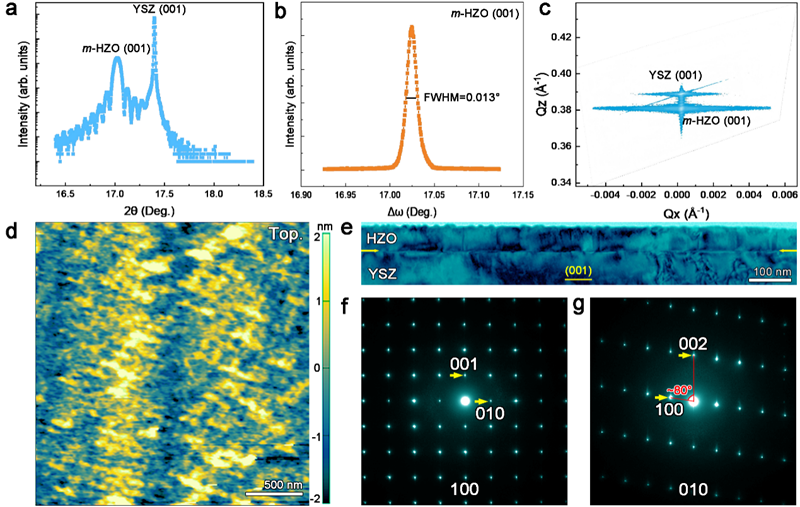
Structural characteristics of monoclinic Hf0.5Zr0.5O2 single-crystal thin films
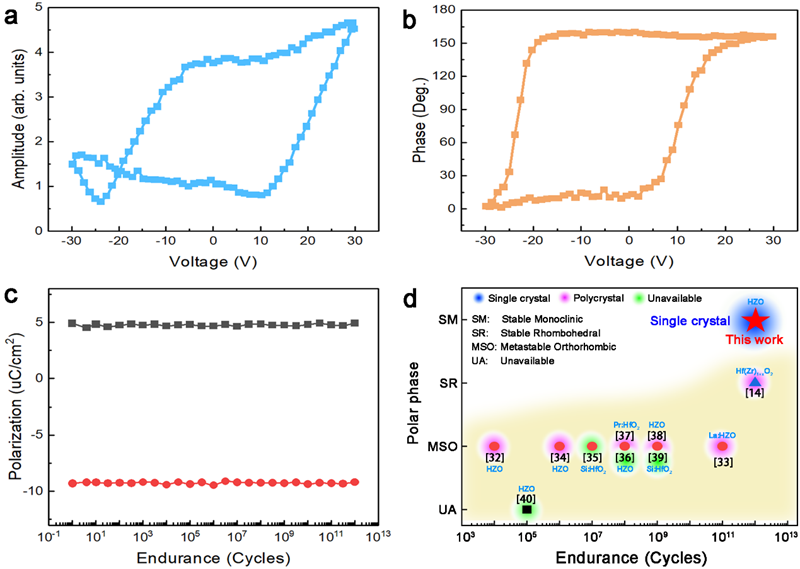
Ferroelectric properties and excellent fatigue resistance of monoclinic Hf0.5Zr0.5O2 thin films
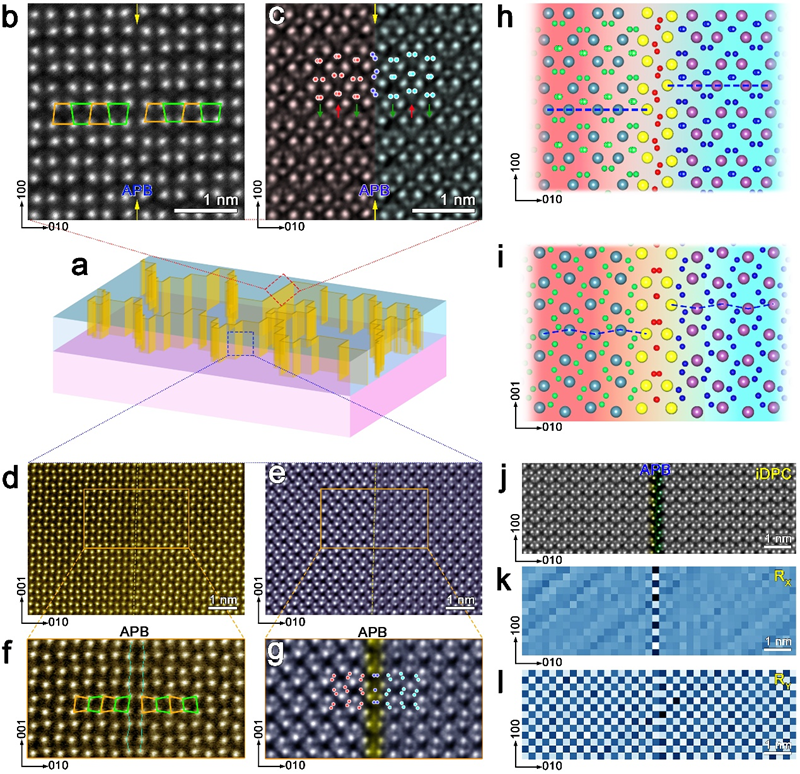
Lattice strain and symmetry mismatch at antiphase domain boundaries leading to the formation of polar variants
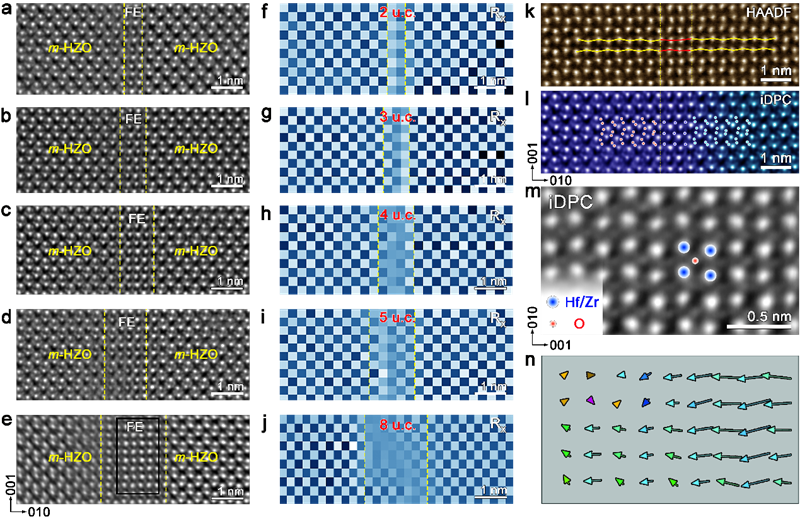
Continuous expansion of antiphase domains at the unit-cell scale, stabilizing a new polar monoclinic phase
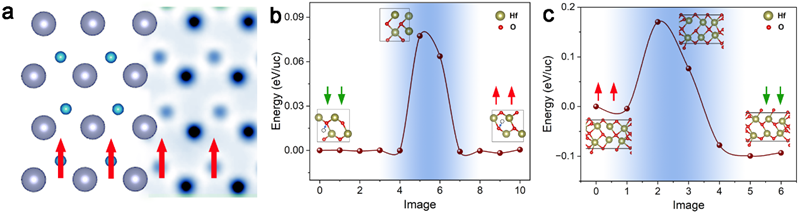
First-principles calculations show that the ferroelectric switching barrier of the new polar monoclinic phase is much lower than that of the metastable ferroelectric orthorhombic phase
Original link:
